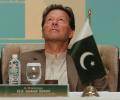
Opposition political parties this month sought a no-confidence motion in parliament to remove Pakistan Prime Minister Imran Khan.

India said on Thursday that it desired normal relations with all its neighbours, including Pakistan, and advised Islamabad to create a conducive atmosphere, including by taking "credible, verifiable and irreversible actions" to stop cross border terrorism against it and enable the two countries to engage and address issues bilaterally.
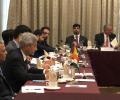
Jaishankar was among the first ministers to arrive for the SAARC ministerial meeting. He was in the meeting for over 45 minutes and then left.

If the Pakistani foreign minister attends the meeting in person, it will be the first such visit from Islamabad to India since 2011.

The external affairs minister reiterated India's position on Afghanistan and highlighted its humanitarian support to the war-torn country, including the supply of wheat, medicines, vaccines and clothing.

'As one might expect, he believed the Indians were preparing their nuclear weapons for deployment. It took us a few hours - and remarkably good work by our teams on the ground in New Delhi and Islamabad - to convince each side that the other was not preparing for nuclear war'
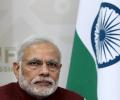
'There is nothing that Pakistan has done which deserves a resumption of dialogue. The assurances made in Ufa contain no commitment except a whole range of talks, which could take place without the paraphernalia associated with a joint statement of prime ministers.'

Pakistan will not engage with India 'until and unless they lift the siege' in Kashmir, it said.

External Affairs Minister S Jaishankar is set to hold separate bilateral talks with his Chinese counterpart Qin Gang and Russia's Sergey Lavrov at a beach resort in Goa on Thursday on the sidelines of a conclave of the Shanghai Cooperation Organisation (SCO) amid rapidly evolving regional security situation.
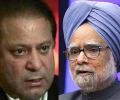
However much one underplays the meeting between India and Pakistan's top leaders, it can never be undervalued, reports Sheela Bhatt.
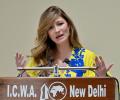
Being with Russia means being on the wrong side of history and Kyiv wants closer and deeper relations with New Delhi, Ukraine's First Deputy Foreign Minister Emine Dzhaparova said on Tuesday while suggesting that the Russian invasion has lessons for countries with 'difficult neighbours'.

Kartarpur Sahib in Pakistan is located across the river Ravi, about four kilometres from the Dera Baba Nanak shrine in Punjab's Gurdaspur district.

'How can any religion have anything to do with terrorism? How was Islam equated with terrorism? And once that happens, how does a man in the western country differentiate between a moderate Muslim and a radical Muslim'

'While the US-Pakistan relationship has been stabilised, it's still mired in uncertainty.'

"We will soon find out. I'm in no rush. There's no testing... If you look at the end of the Obama administration, it was a disaster. What was going on. You don't have that right now. It's a much different feeling. I think people have...there's always danger, but I think people have much different feeling," he said.
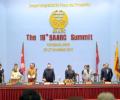
Apart from India, Bangladesh and Bhutan have also pulled out of the SAARC Summit in Islamabad in November, saying the environment is not right for the successful holding of the meet.

Dulat, who was advisor on Jammu and Kashmir to the central government during the tenure of former prime minister Atal Behari Vajpayee, also advocated the need for starting a dialogue with Pakistan.

India shifted gears in rejuvenating strategic ties with its major partners like the US and Russia and focused on drumming up global support for its distinct strategy in the Indo-Pacific to check Beijing's increasing muscle-flexing in the region.
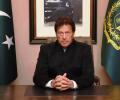
This is the second time after Modi was re-elected to power that the Pakistani premier has expressed his desire to work together with India for the betterment of their peoples.

Wang began a two-day trip to Pakistan on Tuesday primarily to attend a meeting of the Council of Foreign Ministers of the Organisation Islamic Cooperation (OIC) as a special guest.

Mr Modi might have questions to ask himself on the most formidable strategic challenge before India that he inherited from the United Progressive Alliance: The triangulation between China and Pakistan. The failure to break out of it, or even loosen it a bit, is something to reflect on, notes Shekhar Gupta.

Pak's role in Kabul is not sending a good message to India, a top American lawmaker has said

Delegates of all G20 countries, barring China, arrived in Srinagar on Monday for the third working group meeting on tourism -- a much-anticipated event for which authorities have made extensive security arrangements and spruced up the summer capital of Jammu and Kashmir.
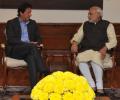
PM Modi telephoned Imran Khan to congratulate him on his party's victory in the general elections

Chinese Foreign Minister Wang Yi arrived in India Thursday evening in the highest-level visit between the two countries after the ties came under severe strain following the eastern Ladakh standoff nearly two years ago.
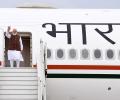
Notably, Pakistan had previously denied the permission of President Ram Nath Kovind and Prime Minister Modi to use Pakistan's airspace thrice to travel to foreign countries in 2019 after India abrogated Article 370 from Jammu and Kashmir.

India scripted history as the ambitious third Moon mission of the Indian Space Research Organisation (ISRO) touched down on the Moon's south pole, propelling the country to an exclusive club of four and making it the first nation to land on the uncharted surface.
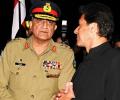
The meeting is being speculated to have revolved around the recent political developments in the country, with the local media reporting that the agenda of the meeting could have revolved around the upcoming Organisation of Islamic Countries (OIC) summit in Pakistan, the ongoing unrest in Balochistan and the upcoming no-confidence motion against Imran Khan.
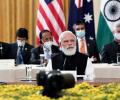
"In all the meetings the Prime Minister had, beginning with US leadership, there was a suo moto recognition of the concerns that Pakistan represents as a country that has in many senses both supported and nurtured cross-border terrorism, including in Afghanistan and from Afghanistan," he said.

With Modi's international image seriously damaged -- perhaps, irrecoverably -- and Indian foreign policy finding itself in drift, we move on to the New Year in a depressing scenario, points out Ambassador M K Bhadrakumar.
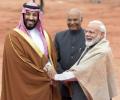
'The more emphatic denial of any proposal for an OIC foreign ministers meet in Islamabad appears aimed at keeping Pakistan on a leash,' notes Lieutenant General Syed Ata Hasnain (retd).

The leaders of the two countries "discussed the main aspects of bilateral cooperation and exchanged views on current regional topics, including developments in South Asia," said a brief statement issued by the Russian President's office - Kremlin.

Prime Minister Modi told President Xi that he has made efforts to improve ties with Islamabad but these efforts have been "derailed".

Pakistan's prime minister is trying to use the unrest in Kashmir to save his government, says Ambassador G Parthasarathy, a former high commissioner to Islamabad.
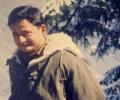
The Supreme Court on Thursday asked the Centre to apprise an 83-year-old mother quarterly about the steps taken to trace her son, Captain Sanjit Bhattacharjee, who has been missing in action and is said to be lodged in a jail in Pakistan for over 25 years.
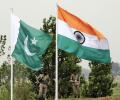
'If there is a background of some kind of mutual understanding on how the dialogue process might develop in a mutually satisfactory manner...' 'If this understanding impacts positively on the ground situation...' 'As of now this is a heroic assumption. But it does not have to remain such.'

'All this talk of 'tactical nuclear weapons' or a limited nuclear war are 'false flags'! It looks like India and Pakistan are slowly but surely inching towards this realism,' says Colonel Anil A Athale (retd).
Khan proposed a meeting between Foreign Minister Shah Mehmood Qureshi and his Indian counterpart Sushma Swaraj on the sidelines of the UN General Assembly in New York this month.
Four Indian authors, including well-known writer Urvashi Butalia, attended the KLF which was held between February 10-12 in Pakistan.
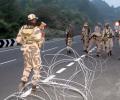
China on Thursday voiced its opposition to India's reported plans to hold the next year's meeting of G-20 leaders in Jammu and Kashmir.
